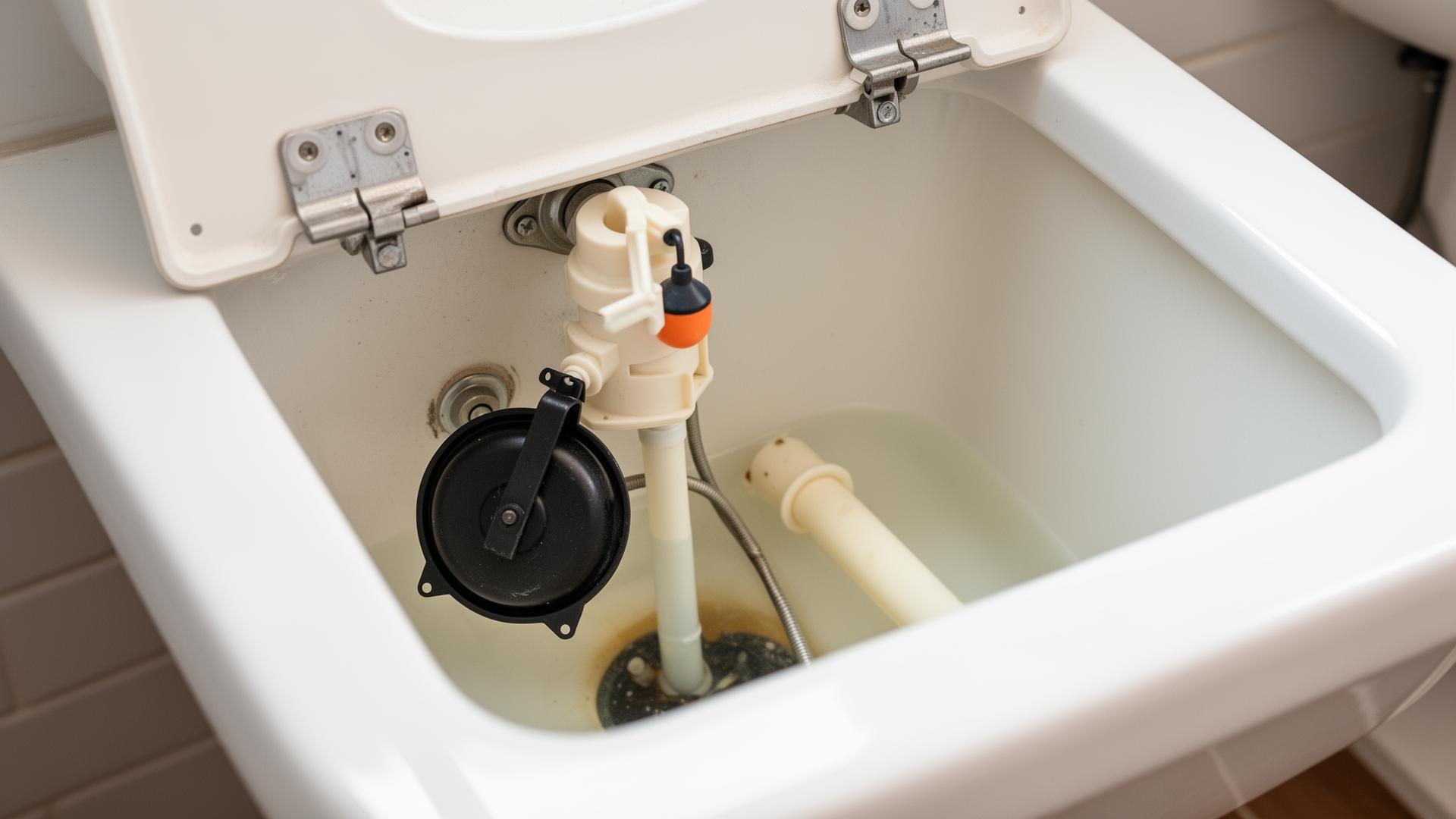
Tools & parts you'll need
Everything fits in a small bag. Hardware stores, Home Depot, Lowe's, and Amazon all stock the parts.
Adjustable wrench
For supply nut and fill valve
Sponge & bucket
To dry the tank
Replacement flapper
Universal, $3–$8
Fill valve kit
Fluidmaster 400A or Korky 528
Food coloring
To test for leaks
Rubber gloves
Optional but recommended
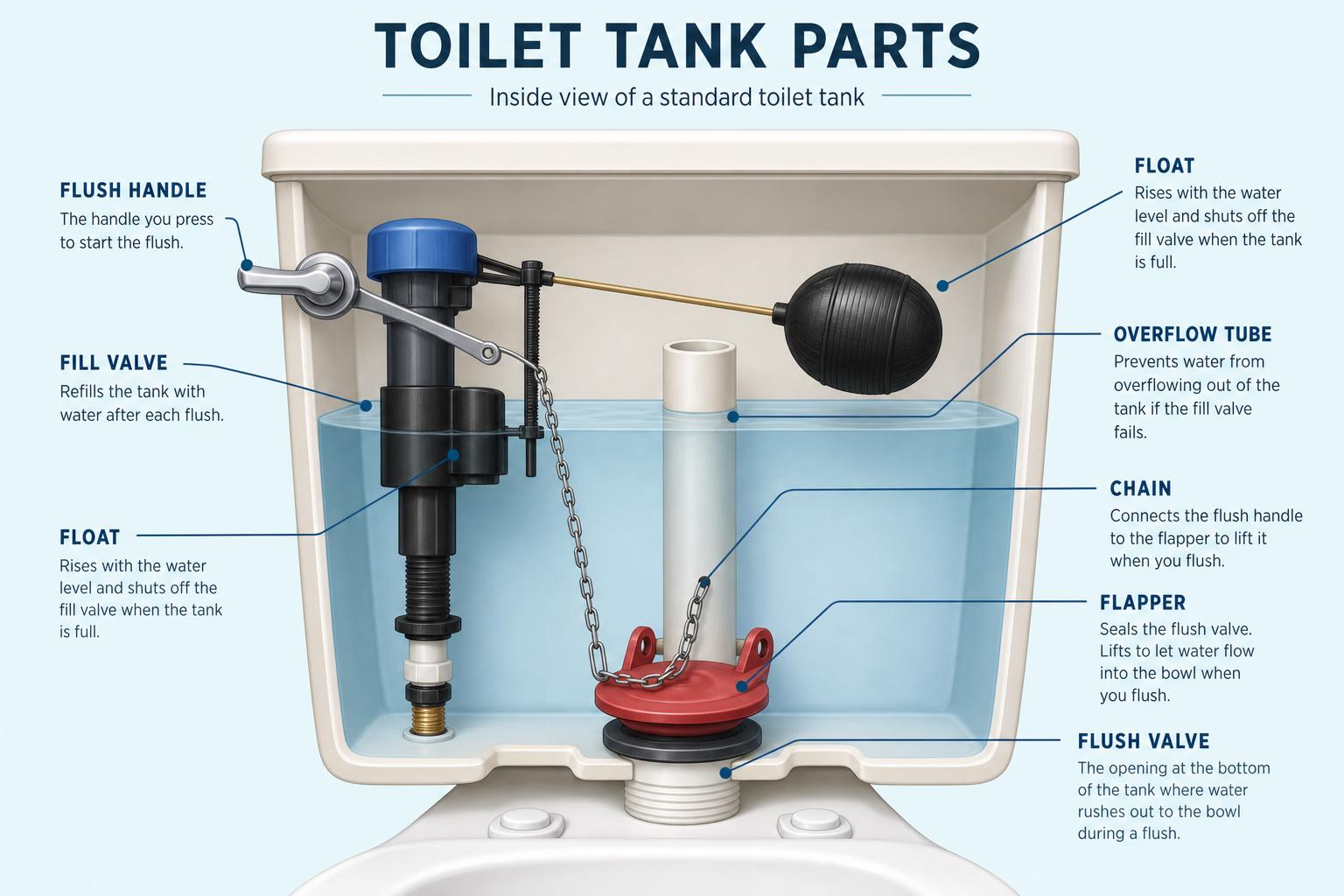
Know your toilet tank
Before you fix anything, it helps to know the names. Almost every running toilet comes down to one of these six parts.
Step-by-step: how to fix a running toilet
Work through these in order. Most people stop at Step 2 or 3.
- 01
Diagnose why your toilet is running
Lift the tank lid and listen. A faint hiss usually means a fill valve problem. Water trickling into the bowl points to a flapper or flush valve leak. A quick test: add 5–10 drops of food coloring to the tank, wait 15 minutes without flushing, and check the bowl. Color in the bowl = the flapper is leaking.
- 02
Check and adjust the flapper
The flapper is the rubber seal at the bottom of the tank. Over time it warps and lets water leak into the bowl, causing the fill valve to refill again and again. Turn off the water supply, flush to drain the tank, and inspect the flapper. If it's stiff, slimy, or warped, swap it for a universal replacement ($3–$8 at any hardware store).
- 03
Adjust the float and water level
If water keeps spilling into the overflow tube, your tank is overfilling. Lower the float so the water shuts off about 1 inch below the top of the overflow tube. On modern fill valves, twist the adjustment screw or slide the float clip down. On older ball-and-arm floats, gently bend the arm downward.
- 04
Inspect the fill valve
If the toilet runs intermittently or hisses long after the flush, the fill valve is likely worn. Replace the seal cap first — that fixes most cases. If it still leaks, a full fill valve replacement (Fluidmaster 400A or Korky 528 are reliable) takes 15 minutes and costs around $12.
- 05
Check the flush handle and chain
A chain that's too short keeps the flapper from sealing. A chain that's too long gets sucked under the flapper. Adjust so there's about ½ inch of slack when the flapper is closed. Replace cracked or sticky flush handles — they can hold the flapper open just enough to keep the toilet running.
- 06
Replace parts if the fix doesn't hold
If you've adjusted everything and the toilet still runs, replace the whole flush valve assembly or fill valve. Universal repair kits ($20–$30) include everything you need and take under an hour. Shut off the water, sponge out the tank, unscrew the old assembly, and install the new one following the kit instructions.
Common causes at a glance
| Symptom | Likely cause | Fix |
|---|---|---|
| Water trickling into bowl | Worn flapper | Replace flapper (Step 2) |
| Constant hissing | Fill valve leaking | Replace fill valve (Step 4) |
| Water in overflow tube | Float set too high | Lower the float (Step 3) |
| Phantom flushes | Slow flapper leak | Dye test & replace flapper |
| Handle stuck down | Tangled or short chain | Adjust chain slack (Step 5) |
When to call a plumber
Call a pro if water leaks from the base of the toilet (not the tank), if the supply valve is corroded shut, or if you replaced both the flapper and fill valve and the toilet still runs. Persistent running after a full rebuild usually points to a cracked flush valve seat, which requires removing the tank.
Frequently asked questions
Why does my toilet keep running?+
The most common cause is a worn or warped flapper that no longer seals the flush valve, letting water leak from the tank into the bowl. Other causes include a fill valve stuck open, a float set too high, or a flush chain tangled around the flapper.
Will a running toilet stop by itself?+
No. A running toilet rarely fixes itself. The underlying part — usually the flapper or fill valve — needs to be adjusted or replaced. Ignoring it can waste hundreds of gallons per day.
How much water does a running toilet waste?+
A continuously running toilet can waste up to 200 gallons per day, adding $20–$70 per month to your water bill, according to the EPA WaterSense program.
How much does it cost to fix a running toilet?+
A DIY fix typically costs $5–$30 for parts (flapper, fill valve, or full repair kit). Hiring a plumber usually runs $100–$200 for the same repair.
Can I fix a running toilet without turning off the water?+
You can adjust the float or chain without shutting off the water, but always close the supply valve before replacing the flapper, fill valve, or any part that requires draining the tank.
What if my toilet runs only at night or every few minutes?+
Intermittent running ('phantom flushing') almost always indicates a slow flapper leak. Run the food-coloring test in Step 1 to confirm, then replace the flapper.